Sunday, January 22, 2012

Stone 22, white, with striped rocks.

Found on the beach.
The land is beginning to move on the south end of the beach near the bulkhead.  A chunk of land plopped out onto the beach, and this skunk cabbage plant was mostly exposed.  I took it home and potted it up.  If it survives, I will plant it back in the park after this round of landslide is done.  If it soaked in salt water, it probably won't live.

Local records indicate there were slides on the property that is now the park in the thirties and the fifties.  During the Depression, men were paid a dollar a day to dig tunnels into the hillside in the park.  This was mostly done to give them work, but it was also done to install drains in an effort to stop the landslides.  The tunnels were big enough for a person to walk into, and they had to be sealed with rocks because neighborhood kids used to explore them.  The only signs they exist are the clay drain tiles sticking out of the slope.  There are three tunnels in the park.  Even if the tunnels weren't there, water would still seep out of the hill all year round.  The drainage tunnels have not prevented slides.  Landslides should not be prevented because they are a natural process.  The sand bars from Eagle Landing Park to Alki Point depend on soil coming out of landslides like those in ELP and Seahurst Park.  Most of the shore is held back by bulkheads, so the areas that do slide occasionally are important to the tidal ecology. 

I saw some white-winged scoters and a Bewick's wren.  Five miles today makes 61 for the year.

Saturday, January 21, 2012


I would like to visit Africa to see the baobab trees.  The only trouble is that I no longer want to travel anywhere without my dogs.  That's okay because the trees of Eagle Landing Park are just as amazing as anything in Africa.  Maybe the alders near the beach are not as massive as African baobabs, but they are sleek and graceful.  Many homeowners consider alders a "junk" tree, something to cut down so you can buy a tree from the nursery.  I don't see how any other tree could be considered more beautiful than the alder.  Certainly no other tree is more beneficial to the environment. 

People have the same variety of opinions about dogs, Canis lupus familiaris.  Well, even my opinion of dogs varies from moment to moment.  Mostly I think they are wonderful.  In certain brief moments, I entertain the notion of taking them all to the pound.  I took all four dogs for a walk in the park today.  I stopped to take pictures, and sure enough, each time I sat all the dogs down and let go of their leashes, someone came along the path.  It is amazing how quickly people come up on you when you are trying to set down a camera and gather four dog leashes. 


People often ask me, "Are your dogs friendly?"  Because I usually have about two seconds to answer, the default answer has to be "No."  The true answer is Yes with an asterisk.  Yes, my dogs are exceedingly friendly.  However, when you get a dog on a leash in tight quarters, she can get tense, and there can be misunderstandings.  I have been asked, "Are your dogs  friendly" by a man with four dogs off-leash, smoking a cigarette in a park where smoking is not allowed.  He did not have control of his dogs, and he kicked one because he could not control her.  In this case, the answer would be, yes my dogs are friendly, but please keep your dogs away since you do not have control of them.  When two dogs meet, and one dog is on a leash and the other is off-leash, it creates an imbalance, and a short bout of snapping and snarling might ensue, even if both dogs are otherwise friendly.  When eight dogs meet in a confined space, and four are on leash and four are off leash, the results can be very unpredictable.  I only have two hands, and it's hard to micromanage four dogs at once.  If I just let all four dogs off-leash, things would probably work out okay, but that's not legal, and it's generally not in the dogs' best interest to be let off-leash in a park.  


A woman with no dogs approached us before I could grab all the leashes.  As my dogs ran up to her to be petted and greeted, she pulled up her hands and asked, in a rising voice, "Are your dogs friendly?"  It sounded a little like, "Are your dogs about to eat me alive?"  I grabbed them as quickly as I could and assured her they were friendly in that circumstance.  


As a general rule, when someone asks if my dogs are friendly, if I say yes, one of the dogs will misbehave and embarrass me.  If I say no, they will all sit there like the happiest, friendliest, safest dogs you ever could hope to meet.  The people we meet have all sorts of attitudes toward dogs, and I cannot say that my dogs will behave themselves in every circumstance.  For example, children often stare directly into a dog's eyes, right at eye level.  In dog language, this is an aggressive gesture.  Each of my dogs has barked at a child who was staring in this manner.  I can't stop and explain to every child that staring like that is rude in dog language.  


The bottom line is, yes, my dogs are friendly.  They are among the nicest people I know.  However, they do have a talent for misbehaving just at the crucial moment.  They have never bitten anyone, human or dog.  Kelsy and Karma work for Missing Pet Partnership, where Kelsy finds lost dogs and Karma finds lost cats.  Komu, the puppy, is in training to find lost cats.  They are not dangerous.  It would be nice if people approaching us on the trail gave us a few moments to get organized so we can be on our best behavior.  If one of my dogs misbehaves, I apologize in advance, and I assure you that you are not in danger.  A little patience and understanding would be greatly appreciated.

Friday, January 20, 2012


It would be hard to imagine a gloomier day, and I loved it.  Ice fell from the trees onto snow no longer white.  The cold rain fell through misty air.  Puget Sound's glassy surface showed each raindrop as it fell.  No one else ventured into the park except me and the ducks.  They dove down into the eel grass beds for their meals.  If you have to dive into Puget Sound for a living, you don't care if it's cold and raining.(I think the diving birds were horned grebes, but I didn't have binoculars, so I can't be sure.)


I don't particularly like the staircase because it attracts people who come to the park only for the stairs. (I have no objection to people climbing stairs for exercise.  It is even possible that most people who climb the stairs also appreciate nature.  There seems to be a minority of people who think the rest of the park is just something you have to get through to get to the stairs, and these people don't feel they should have to take care of the environment.) Even if I think the stairs fit the definition of Attractive Nuisance, they do make it much easier to get to the beach when the earth is mud and ice.  Also, the stairs protect the slope.  If a trail had been cut into the steep hillside, it would channel water, kids would make shortcuts, and the slope would probably slide much sooner than its natural schedule, wiping out the trail.  In a natural environment, the stairs are violently unnatural, but they do protect the environment.  The slope does appear to be getting ready to slide.  This is landslide season, and the forecast for the next ten days calls for rain every day.  The waves at high tide have hollowed out a cavern under the wooden steps closest to the beach.  The alders north of the stairs are completely undermined.  At the south end of the beach, near the bulkhead, water from a spring is cutting under an alder.  There were small landslides in 2008, 2009, and 2010.  I would be surprised if we didn't have another landslide soon.  The wooden stairs at the bottom may fall into the sea, but the concrete landings will be the last thing to go.  The concrete portion you see is really just a cap.  All the weight of the stairs is supported by pin pilings that were driven into the earth as far as they could go.  Each concrete landing is filled with Styrofoam.  They look massive, but they are relatively light. 

Falling branches bring the canopy down so we can study it.  This branch fell from 70 to 80 feet.  Stone 20 is pictured with at least three species of lichen.  I think the one on the right is Lobaria.  I will try to take a good camera and get a better picture. 

Thursday, January 19, 2012

An ice storm hit the park this morning, bringing down a few large branches and making the twigs look stunning.  The dogs stayed home because of the risk of falling limbs.  I heard several large trees creak and crack.  I cleared large branches from the path in several places.  The hazelnut branches dipped down into the path.  I left most of those alone because they should spring back up tomorrow when the ice melts.  Mostly, I took lots of pictures, as seen in this gallery.

Hazelnut trees and a few non-native hazelnut trees make up the majority of the middle story, between the shrubs and the big trees in Eagle Landing Park.  I might like to try a hazelnut someday, to see how they taste, but the squirrels and bluejays leave absolutely zero behind.  If you think you see a hazelnut ripe on the branch, it will turn out to be empty inside.  The native Corylus cornuta and the non-native Corylus avellana look very similar.  The non-native has catkins that are lighter in color, almost white.  The catkins of the native are darker, beige to almost brown.  When I asked the scientist from EarthCorp if we should worry about removing the  non-native Corylus avellana from ELP, he replied that it should be the last thing we worry about when removing non-native species.  They are so nearly identical in form, habit, and function that the non-natives don't pose a threat.  They aren't out-competing the native hazelnuts yet.  They don't appear to hybridize with each other.

I walked a couple of miles on the ice, and collected stone 19, pictured below on driftwood.

Wednesday, January 18, 2012

About five inches of snow fell last night.  The red huckleberry pictured above has hundreds of tiny little buds ready to burst into leaf.  Hopefully, winter will be done with this sort of weather after tomorrow, and buds can begin to open without too much risk of damage.  Red huckleberries were prized by native Americans, who burned sections of the forest in order to keep the huckleberry plants healthy and plentiful.  The burned huckleberry bushes would shoot up from the roots, forming lush new plants, and the trees that would normally shade out the huckleberries would have to start over again.  I can think of only two red huckleberry bushes in the park, neither of which gets enough sun to produce much fruit.  In the future, since no one will be setting ELP on fire, red huckleberry may dwindle away.  If a major tree falls and clears a new opening in the canopy, that might provide an opportunity for a few new red huckleberries.  You can read about controlled burns for huckleberry yields here.

Although ELP won't be managed with controlled burns, given the proximity of houses on all sides, it will be a managed forest in many respects.  Humans will be choosing what species are planted in the park, and the forest will always rely on volunteers to control invasive species.  Sections of northwest forest have been managed by humans for ten thousand years.  Indians used natural processes, similar to wildfires started by lightning, to renew the forest so that pioneer species and plants that love sun could survive and flourish.  Human numbers were small enough, from 10,000 years ago to 150 years ago, that this management of sections of the forest still left the majority of the forest to progress on its usual course.  Those humans integrated themselves into the forest in ways that we cannot.  ELP would suffer if too many people chose to forage for food from native plants within the park.  We can integrate ourselves into the forest in ways that those first humans could not.  We can photograph the natural beauty found there, and we can learn all about the more than 365 species within the park.  Using science and technology, we can delve into the forest more than ever.

Today's walk took us from the beach to the library and back (4 miles), taking pictures all the way.  A gallery of images from ELP and from around Burien can be seen here.  Stone 18 is tucked in the crevice of the steps in the picture below.

Tuesday, January 17, 2012


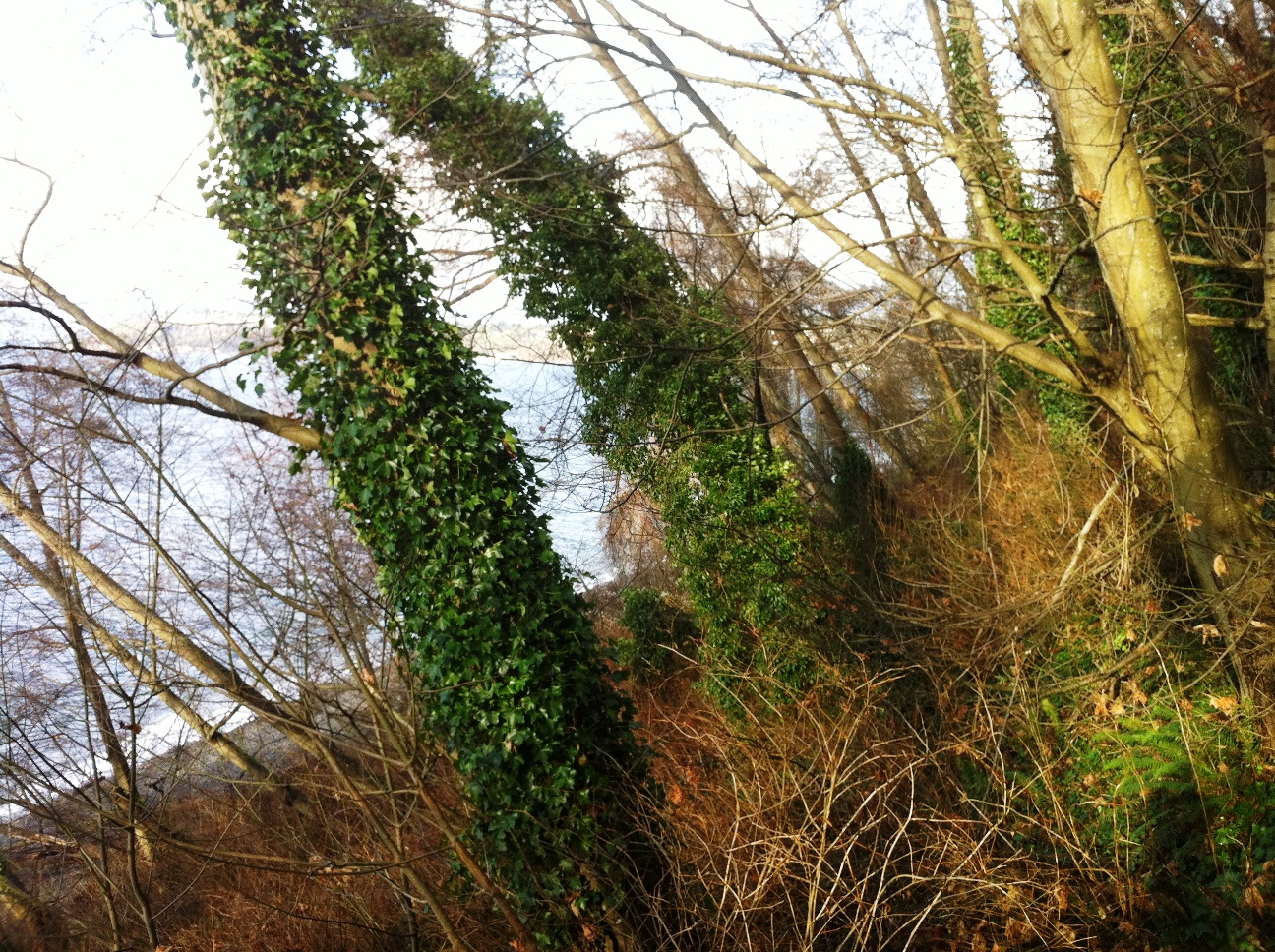
The two alders above are probably in the most need of help in the park.   If they fall while the ivy is alive, they will spread the infection further.  I will try to get to these trees soon.  The section of forest below is actually healthy.  I couldn't see any invasive species from the trail, although there may be something lurking in there.  The health of this section is probably due to a robust colony of salal, which keeps invasive species from geting started. 
Springtime pic of salal flowers.
Salal is very tough and versatile, growing in dry to wet conditions, full sun to mostly shade.  Some people complain that it is almost impossible to kill in their yards, which makes me happy.  Even though it is tough, it can also be tough to start.  It needs that micorrhyzal association.  I have planted salal in several locations in the park, in habitat where other plants are flourishing nearby, and it has died on me.  It is a little sad, the number of plants I've inadvertently killed while trying to improve the park.  Salal does not like extreme fluctuations in moisture, and organic material in the soil and micorrhyzae can even out the moisture.  Until that association is established, you need to water it regularly, and not let it get too dry during our dry summers.  Because of this fungal association with the roots, salal does not transplant well.  You need to get the whole root, which is often eight feet long running just under the surface of the soil.  If you dig up just the roots within a foot of the plant, it will surely die.  King County hosts salvage events, where you can salvage native plants from sites scheduled for construction.  You can use these plants for restoration in local parks, or for your own yard.  I have seen acres of salal that were going to be bulldozed, but I couldn't take any home because it just wouldn't survive.  Salal is an invasive plant in England.  I would be happy to get back at them for what they've done to us with English ivy, but I don't want any plants to be invasive anywhere in the world.

Above is stone 17 with ivy and lichen on maple bark. 2 miles today.

Monday, January 16, 2012

Humans are symbiotic with the biosphere to some extent, whether or not we choose to be.  We breathe out carbon that trees need, and we consume oxygen that would poison the world if too concentrated.  Beyond a few functions like that, humans are parasitic on the biosphere, even though we have the capacity to be symbiotic in all our functions.  We consume the Earth's resources to the detriment of the Earth, and often to our own detriment as well. Our current economy relies on conspicuous consumerism, no matter how bad it is for us or the planet.

Members of a symbiotic relationship do not perform their functions for altruistic reasons.  They do what they do for their own benefit, to become something more than what they could be alone.  The forest of Eagle Landing Park is made possible by micorrhyzae in the soil.  Invisible to us, this fungus in the ground allows trees to become big and strong, and grow much faster than they would without this fungal association.  Fungi, often the main body of the organism that we see as mushooms, wrap around the tiniest branches of tree roots, coating them.  The fungi provide better water and mineral absorption for the trees by being more efficient at interfacing with the soil.  The fungi has a larger surface area, and it releases chemicals to allow the transfer of minerals.  The trees, in turn, provide sugars to the fungi, for food.
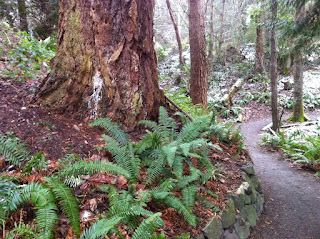

All of the trees in Eagle Landing Park are connected underground by their roots and by the fungi that form this symbiotic relationship with them.  Trees can exchange sugars, carbon, and minerals with each other by way of these micorrhyzal fungi.  This may be the only thing keeping some trees alive.  At the top of the park, near the beginning of the trail, a retaining wall was cut into the soil near a giant Douglas-fir.  This excavation occurred in the well-known critical root zone.  (The critical root zone is well known in the sense that anybody doing construction or landscaping would know about this, and if you don't know about the critical root zone, you should not be allowed within ten feet of a tree.  According to the formula, they should not have done any excavation within 48 feet of that tree.)  You could not get a permit to damage a significant tree on your own property with a retaining wall like this.  Indeed, the plans provided for construction did not place the wall there.  No one seems to know why the workers chose that spot for the retaining wall.  They undoubtedly severed and damaged many main, vital roots for this giant tree.  It may still succumb to the damage, as some trees take ten years to die after the fatal wound.  However, it may survive because there is another large Douglas-fir about twenty feet uphill of this tree.  Their roots must grow near each other, and this micorrhyzal association allows them to exchange nutrients, sugars, minerals, and water.  Their roots interlock, providing stability.  The two trees grow as a unit.  One gets more light and the other can harvest more moisture.  One trades sugars with the other, for moisture and support.  Because of the symbiotic micorrhyzae, the trees are able to help each other survive.  Throughout the park, you can see examples of trees of a species growing in groups of two or three, helping each other grow faster and better because of their root networks.  Yes, they grow there because that's where the seeds fell, but they survived and flourished because of their connected roots and the micorrhyzae hidden in the soil.
 Stone #16 is pictured above, front and center, with another interesting stone and two crab shells.  The crab shell above is covered in barnacles, in what appears to be a mutualistic relationship.  The barnacles get transportation to new waters for feeding, and the crab gets camouflage, looking like a rock with barnacles on it. 

I saw a currant blooming today.  A bad picture because all I had was my iPhone and my hands were shaking with the cold.  (The currant is probably a cultivar and not a true native.  It was planted when the park was built, and did not grow from local seeds.)  The dogs and I walked 4 miles, to the beach, to the library, and back. 43 total miles.