Sunday, January 29, 2012


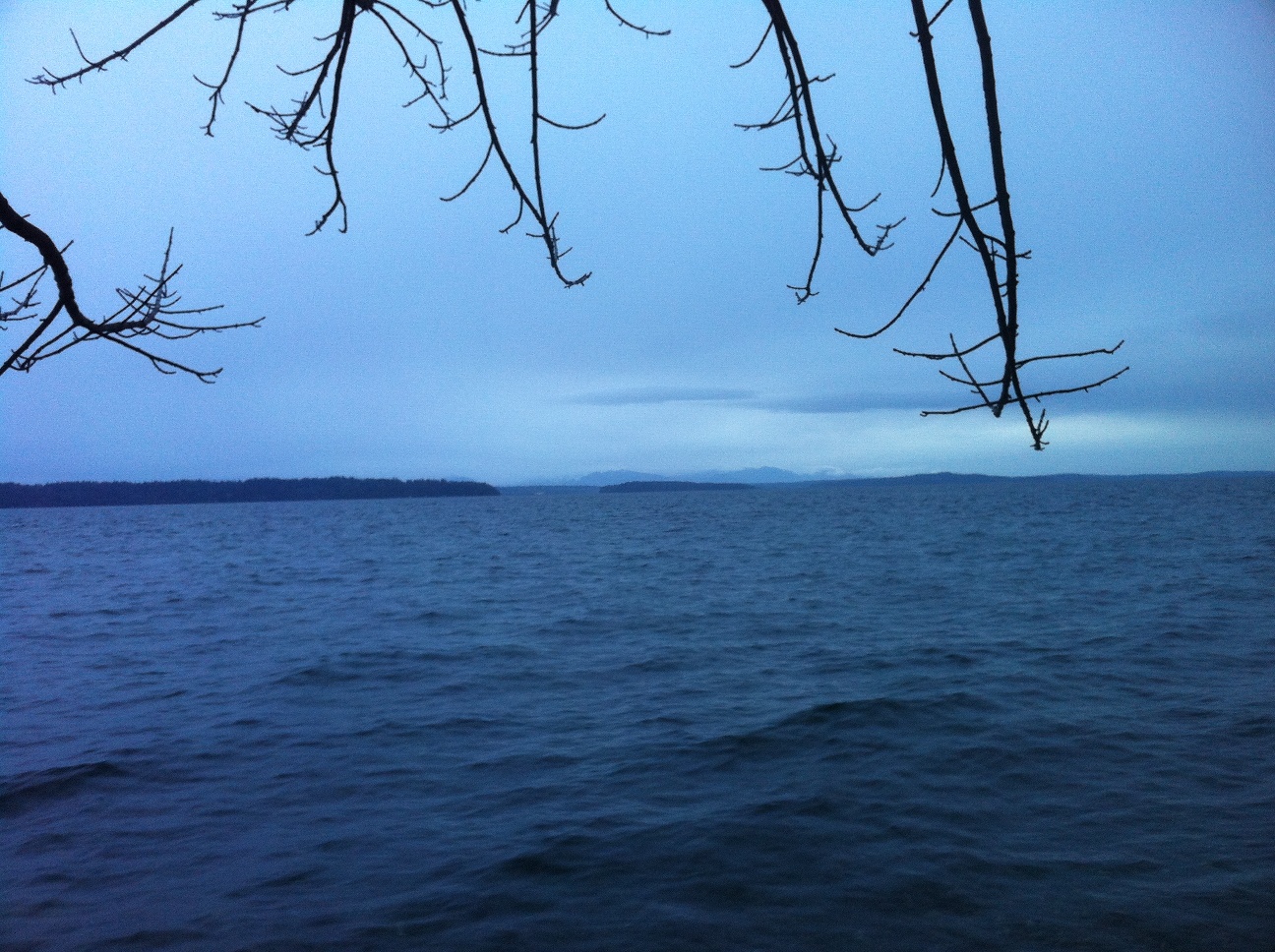
Eagle Landing Park is my church, and ecology is like a religion to me.  I put on my Sunday best: boots, rain coat, and floppy hat.  I gather the family, the four dogs, and head off to church.  The sermon today is wind in the tree tops, and silence.  In the light rain and gloom, no birds sing, not even the screech owl.  I walk through the columns and arches of the trees and branches.  It is a style of architecture that lifts me up and focuses my thoughts.   Everywhere, my church is adorned with the artwork of nature, the infinite variety and complexity of leaves, branches, tendrils, and buds.

Nature is my Creator.  It is a simple, undeniable truth.  I am a part of nature, giving and taking.  For my acts of charity, I give my time and labor to the church, restoring the ecosystem as I restore myself.  My form of worship is to walk and watch, listen and learn.  With my words and photographs, I hope to capture the beauty and magnificence of nature.  I am in Paradise when I walk through the biosphere, and I do not look for another paradise elsewhere.

Nature, my Creator, has given me immortality.  I am thirteen billion years old, the latest in a series of configurations of atoms reaching back to the beginning.  The carbon in my body was forged in a supernova billions of years ago.  The code in my genes is shared with all other species in this church.  When I no longer keep my current form, I will return to nature and give my strength to her, living on forever in some other form, a part of my biosphere.

Life on Earth is sacred and singular.  If life exists elsewhere in the universe, no other planet among the trillions of planets has life quite like that on Earth.  My main purpose in life is to defend the sacred life of Earth against those who would abuse and destroy it.  I protect this park, my church, as my own little corner of the biosphere, the place where I can have the most impact.

I have faith in science and nature.  I believe that humans are capable of wisdom and kindness.  Although people have abused and destroyed ecosystems for the past few centuries, I have faith that people will find it in their own best interests to preserve this Earth, to restore nature to her past glory.  I kneel in my church to touch the soil, the living, breathing flesh of my Creator.  I visualize a future where humans once again live in harmony with nature.

I come to my church to find peace.  There may be others who appreciate the sacred and holy nature of this place, even if we don't outwardly express such thoughts to each other.  Some come to the park for benign recreation that does not detract from the beauty of my church.  A few people defile this church either out of ignorance of its beauty and significance, or out of deliberate malice.  If there is a reason for these malicious acts, nature should not be the target.  Justice is not served by harming this church.  Those who harm my church cause harm to me.  This place is my community and my home.  Damage to the park wounds me.  This is a choice on the part of those causing the damage, to hurt this place and hurt its people without necessity or reason.  When they cause this meaningless destruction, they diminish their own lives.  Those causing harm can also choose to end those practices and acknowledge the sacred beauty in this park.  This park is me.  This park is my identity.  I am not one of those people who would deliberately harm this place and all the species present.  My park, my church, allows me to know who I am and who I am not. 

All are welcome in this public park, this church without doors.  Nature bestows her blessings on all who enter the park.  This church can accommodate all kinds, and all who visit this cathedral have the opportunity to give, to leave this place better than they found it.  Anyone can worship here.  Anyone can find peace and solace in this serene sanctuary.

Saturday, January 28, 2012


We saw the Great Blue Heron today.  Spotting one made me realize that I haven't been seeing them much lately.  I used to see one every day, but now I'm seeing the first heron of the year on January 28th.  It could be that my walking routes and times have changed, or that the eagles have been eating them.  They should reach a stable population if we don't interfere with nature too much.  Many predators are gone from ELP, so the food chain is not what it used to be.  Deer, bears, wolves, mountain lions, rabbits, elk, and others are gone from this forest, unlikely to return any time soon.  The avian predators and the fish can still use this ecosystem as if it were an island, isolated by a sea of homes and pavement. Herons are somewhat tolerant of the presence of humans, but they will be disturbed from their fishing if you get too close.  I snapped a picture of the heron for Project Noah, but the iPhone is not ideal for photographing birds.  Some day soon, I will have to go hunting for birds with my telephoto lens on the good camera and see how many species I can bag. 

If a heron was fishing in the shallow water, would you adjust your walking route to give him some space and avoid disturbing him?  Most people hate nature, others are indifferent, and very few people actually appreciate and enjoy nature, judging by the way they manage their yards.  As I walk my dogs through the neighborhoods between Eagle Landing Park and City Hall, I see that nature has been banished from most yards.  They have grass and shrubs and maybe a few trees, but that is not nature.  That is horticulture.  The horticulture industry  makes money by ruining nature.  Horticulture, by definition, says that humans can improve on nature, that nature is inferior.  Horticulture is what most people have and want in their yards.  Very few native plants survive in the yards of suburban homes.  In the neighborhood near ELP, many large native Douglas-firs remain, left standing when the homes were built.  However, those trees are steadily being reduced in number, year after year.  The sound of chainsaws is very common around ELP.

Bringing Nature Home is one of the best books ever written, and if I were King of the World, I would force everyone to read it.  If everyone in Burien read the book and planted their yards full of native plants in place of those acres of lawn, Eagle Landing Park would be much healthier and happier.  What I don't understand is why people think horticultural varieties and exotic species are more beautiful than the native plants that would naturally grow here.  What is it that people hate about nature?  It must be instinctive somehow, a primitive impulse from those days when we were more often prey than predator.  Now, humans pose the greatest danger to humans.  If this hatred of nature is left over from our evolutionary past, then we need to get over it somehow.

I did not always appreciate nature and native species.  I used to be like everyone else, thinking a mowed lawn and a pruned hedge and showy flower cultivars were somehow better.  I would say that education has made the biggest difference in bringing me around to loving nature and native species.  The only reason I can think of that I ever held an anti-nature mind set is that I was brainwashed by society and commerce.  If you would like to un-brainwash yourself, here is a partial list of excellent books to help you appreciate the gifts of nature.


Field Guide to the Rare Plants of Washington
Joseph Arnett
(2011) ISBN: 9780295990927

The Owl and the Woodpecker: Encounters With North America's Most Iconic Birds
Encounters with North America's Most Iconic Birds
Paul Bannick
(2008) ISBN: 9781594850950
The Emotional Lives of Animals
A Leading Scientist Explores Animal Joy, Sorrow, and Empathy - and Why They Matter
Bekoff
Jane Goodall
(2008) ISBN: 9781577316299

Birds of Washington State
Brian H. Bell
Shane Kennedy
(2006) ISBN: 9781551054308

Northwest Foraging: Wild Edibles of the Pacific Northwest
by
Doug Benoliel
ISBN: 9780913140130

The People of Cascadia
Pacific Northwest Native American history
Heidi Bohan
(2009) ISBN: 9780984252206

Rain Gardens
managing water sustainably in the garden and designed landscape
Andy Clayden
(2007) ISBN: 9780881928266


Trees
Allen J. Coombes
(2002) ISBN: 9780789489890

vascular Plants Of The Pacific Northwest
Cronquist
Charles Hitchcock
ISBN: 9780295739878

Origin Of Species
Charles Darwin
ISBN: 9780785819110

Climbing Mount Improbable
Dawkins
Richard Dawkins
(1997) ISBN: 9780393316827

The Blind Watchmaker
why the evidence of evolution reveals a universe without design
Richard Dawkins
(1986) ISBN: 9780393315707

The Extended Phenotype
the long reach of the gene
Richard Dawkins
(1999) ISBN: 9780192880512
Collapse
How Societies Choose to Fail Or Succeed
Jared Diamond
(2011) ISBN: 9780143117001
Forest Restoration in Landscapes: Beyond Planting Trees
beyond planting trees
Nigel Dudley
(2005) ISBN: 9780387255255
Mushrooms
Neil Fletcher
(2002) ISBN: 9780789489869
Evolutionary Biology
Douglas J. Futuyma
(1998) ISBN: 9780878931897

The Tree Collector
the life and explorations of David Douglas
Syd House
(2005) ISBN: 9781845130527

Restoring the Pacific Northwest
the art and science of ecological restoration in Cascadia
Society for Ecological Restoration International
(2006) ISBN: 9781559630788

Wild Plants Of Seattle
Arthur Jacobson
ISBN: 9790962291820

Animals in Translation
using the mysteries of autism to decode animal behavior
Catherine Johnson
(2006) ISBN: 9780156031448

Plants of Western Oregon, Washington & British Columbia
Eugene N. Kozloff
(2005) ISBN: 9780881927245

Gardening With Native Plants of the Pacific Northwest
Kruckeberg
Arthur R. Kruckeberg
(1996) ISBN: 9780295974767

The Natural History of Puget Sound Country
Kruckeberg
Arthur R. Kruckeberg
(1995) ISBN: 9780295974774
Living With Wildlife in the Pacific Northwest
Russell Link
(2004) ISBN: 9780295983868

Natural Capitalism
creating the next industrial revolution
L. Hunter Lovins
(2000) ISBN: 9780316353007

The Hidden Forest
The Biography of an Ecosystem
Jon R. Luoma
(2000) ISBN: 9780805064483


Native American Medicinal Plants
an ethnobotanical dictionary
Daniel E. Moerman
(2009) ISBN: 9780881929874

Hiking Olympic National Park (rev)
Erik Molvar
(1996) ISBN: 9781560444572

Between Earth and Sky: Our Intimate Connections to Trees
our intimate connections to trees
Nalini Nadkarni
(2008) ISBN: 9780520248564

Lichens of North America
Canadian Museum of Nature
(2001) ISBN: 9780300082494

Best Hikes With Dogs Western Washington
Dan A. Nelson
(2002) ISBN: 9780898868296

The Bond
Our Kinship with Animals, Our Call to Defend Them
Wayne Pacelle
(2011) ISBN: 9780061969782

Winter Twigs
a wintertime key to deciduous trees and shrubs of northwestern Oregon and western Washington
Patricia L. Packard
(2001) ISBN: 9780870715303

Champion Trees of Washington State
Robert Van Pelt
ISBN: 9780295975634


The Butterflies of Cascadia: a Field Guide to All the Species of Washington, Oregon, and Surrounding Territories
a field guide to all the species of Washington, Oregon, and surrounding territories
Robert Michael Pyle
(2002) ISBN: 9780914516132

The Red Queen
sex and the evolution of human nature
Matt Ridley
(1993) ISBN: 9780060556570

Encyclopedia of Northwest Native Plants for Gardens and Landscapes
Kathleen Robson
(2007) ISBN: 9780881928631

Propagation of Pacific Northwest Native Plants
Robin Rose
(1998) ISBN: 9780870714283
Moss Gardening
including lichens, liverworts, and other miniatures
George Schenk
(1997) ISBN: 9780881923704

In My Nature: a Birder's Year At the Montlake Fill
a birder's year at the Montlake Fill
Constance Sidles
Alexandra MacKenzie
(2009) ISBN: 9780984200207


Bringing Nature Home: How You Can Sustain Wildlife With Native Plants
how you can sustain wildlife with native plants
Douglas W. Tallamy
Rick Darke
(2009) ISBN: 9780881929928
4 miles today brings me to 75 for the year.

Friday, January 27, 2012

15,000 years ago, Eagle Landing Park was buried under 3,000 feet of ice.  If you stand on the beach today and look across at the Olympic Mountains, that's about half way up the highest peaks you see.  Solid glacial ice.  The glacier retreated by about 11,000 years ago, and Douglas-fir trees marched back into the barren landscape to repopulate the lands where they lived before the glacier.  Those first pioneering Douglas-firs grew on soil lacking any organic material, any life.  As those trees lived and died on this land for 10,000 years, the soil became alive, full of decaying organic material and teeming with bugs, microbes, and fungi.

Over 100 years ago, most or all of the trees were stripped off the land.  The soil remained, mostly untouched.  The living, breathing soil of Eagle Landing Park is 10,000 years old.  The individual organisms may be young, but their genomes are ancient.  The above-ground portion of the forest had to start anew, but the below-ground forest lived on after the logging, mostly unaffected.  When the Douglas-firs grew again, those micorrhyzae were waiting for them.

The soil is very fluffy in most places.  When I want to plant a small plant, I just stick my hand into the earth and feel around for the openings.  I push the soil aside a little, distrubing it the least amount.  To plant a larger tree, I need a shovel, but that is to chop through the roots of other plants in the way.  Although I hate to disturb the soil, the living skin of the park, I do enjoy the feel and smell of having my hands in the soil.

Jon Luoma tells us there may be thousands of creatures under your foot each time you take a step.  If I could count those critters, I would have no trouble reaching 365 species this year.  One critter that does not belong there is the earthworm.  Most worms that you see are not native.  When the glacier retreated, the Douglas-firs marched into lands without most of the worms that we think of as naturally being in the soil.  Those invasive worms may be changing the makeup of the soil, and they may make it difficult to restore Eagle Landing Park to the way it once was.  Of course, no one made an accurate record of the forest before it was cut down, so we have to make educated guesses as we restore the forest to its former state of health.  But as much work as there is to do above ground, removing invasive species, below ground the park is fairly healthy, as far as I know.


Thursday, January 26, 2012


I cataloged about twenty species for Project Noah today.  It is an app and a web-based tool that lets you register the species you photograph.  I set up a "Mission" for Eagle Landing Park.  Hopefully others will join in and help me find 365 species within the park.

On the way out, a couple of kids about 11 to 13 years old were up to something.  It sounded like they were making plans for building a fort or something.  It's what I did when I was a kid.  When I was young, we played in the vacant lot.  There are no more vacant lots, at least not in this area, and public parks are serving that purpose.  Having been a boy of a certain age at one time, I know that there is no more destructive force on the planet.  It would be nice if someone, not me, could redirect them toward more positive uses of the park.

I understand the need for play.  Having three dogs and watching out for a fourth, I certainly understand the need for play.  But, as I am teaching my 80-pound puppy, there are lots of ways to play where no one gets hurt.  He used to play too hard and make all the other dogs mad.  Now he is learning not to bite, when they've had enough, and how to romp around without leaving a trail of destruction.  He is learning what is okay to chew and what is not.

I see this as a real positive with Project Noah.  It gives everyone a chance to play.  Kids can do it, too.  It's like geocaching, in a way.  Instead of hunting for a hidden treasure which turns out to be a trinket or nothing, you hunt for hidden treasures that are hiding in plain sight, the plants and animals in your local park.  I set up this entire biography of ELP as a game, a challenge to collect 365 stones on 365 consecutive days.  I like the game aspect of Project Noah for the same reasons.  It is a challenge.  You have a tangible achievement each time you capture a trophy, a species, and no one gets hurt.  The link to Project Noah is in the upper right corner of this page, and I hope you will check it out.


Stone 26 is lurking in the pool in the clay. 

Wednesday, January 25, 2012

Komu walked with me on another gloomy afternoon just before the sun set unseen behind the clouds.  I couldn't take many pictures because of the darkness.  We came up through the community beach property and cut down the bamboo encroaching on the Douglas-fir saplings.  As I worked and Komu milled about, a screech owl kept us company with her melancholy call. 

The call of a screech owl means dusk.  I have heard them for decades in these woods, and that sound is just a part of the forest.  Sometimes you hear two or three, but you almost always hear at least one.  But you never see them.  In several decades (at least) of hearing them, I have only seen one once.  They are about nine inches tall and weigh five ounces.  They prey on mice, voles, bats, insects, and even butterflies.  They prefer open woods or the edges of woods. 
After grabbing their prey, they need to return to the safety of the canopy or their nest because other birds prey on them.  Great horned owls haunt these woods from time to time, although I don't hear them as often as the Screech owl.  Great Horned Owls are ferocious hunters, and even eagles are afraid of them.  Barred owls also come by these woods a few times a year.  Although I would like to see the screech owls, I understand they need to stay out of sight of the larger predators.

You can hear them for yourself at dusk in the park, or listen to the recording on this page.

Tuesday, January 24, 2012

The dogs didn't want to go for a walk today because it was rainy and gloomy, and someone in the house was eating.  I was the only one in the park, and it was a dark day well before sunset because of the low, thick clouds.  Near the bottom of the stairs, a sparrow called loudly to someone.  I was the only one around, but I didn't know what to say.  I think it was a Song Sparrow.  He or she hopped around in the salmonberry.  The high tide left very little beach.  More of the south end had fallen away.  You can see the exposed clay, the reason for the sliding hillside.  Water hits that clay layer and can't go anywhere.  The sandy soil sits on top of that water on the clay.  I almost slipped and fell on the wet clay just standing there looking at the hill.  Water runs out of the hill constantly, whether it's raining or not.  High winds are coming tonight, although not at peak tides.

I came back up through the community beach property to the south.  The skunk cabbage was not showing yet.  A large clump of bamboo is leaning over the Douglas-firs I planted a few years ago, shading them out.  I wish I had brought my pruning saw. 

In a healthy forest, a landslide or a fallen tree is an opportunity for native pioneer species to fill in.  In a compromised forest like ELP, each little natural disaster is an opportunity for unnatural invasive species to get a better hold on the forest.  As the gloomy day got darker, instead of enjoying my walk in the woods, all I could think about was the work I need to do, and what could happen if we don't get these invasive species under control. 

Monday, January 23, 2012

The pileated woodpecker tore into an alder tree near the top of the park.  Here is a video shot in 2008 of a woodpecker tearing apart an alder near the parking lot.  Decaying alders may be more alive than when they were alive.  Bats may nest under the buckled bark.  Termites drill into the soft, rotten wood, and woodpeckers dig the termites out.  Flickers may cut out a nest inside the trunk of a dead alder.

If you are patient and lucky, you may get to see two flickers do their courtship dance.  They bob their heads at one another while making funny little squeaks.

 In the picture above, there is a tiny little spider on the wax paper lichen.  Look closely and see if you can find it. 


These are the same stones I photographed yesterday, but with sun on them.
bug closeup