Sunday, February 5, 2012
I had to find today's stone by the roadside because a busy day kept me from walking through the park during the hours it was open. Many people ignore the posted closing time, but I can wait until the next day. I can see my forest from the outside, and I imagine the damage by the beer drinkers and fire builders will probably be minor. We will go tomorrow.

Saturday, February 4, 2012
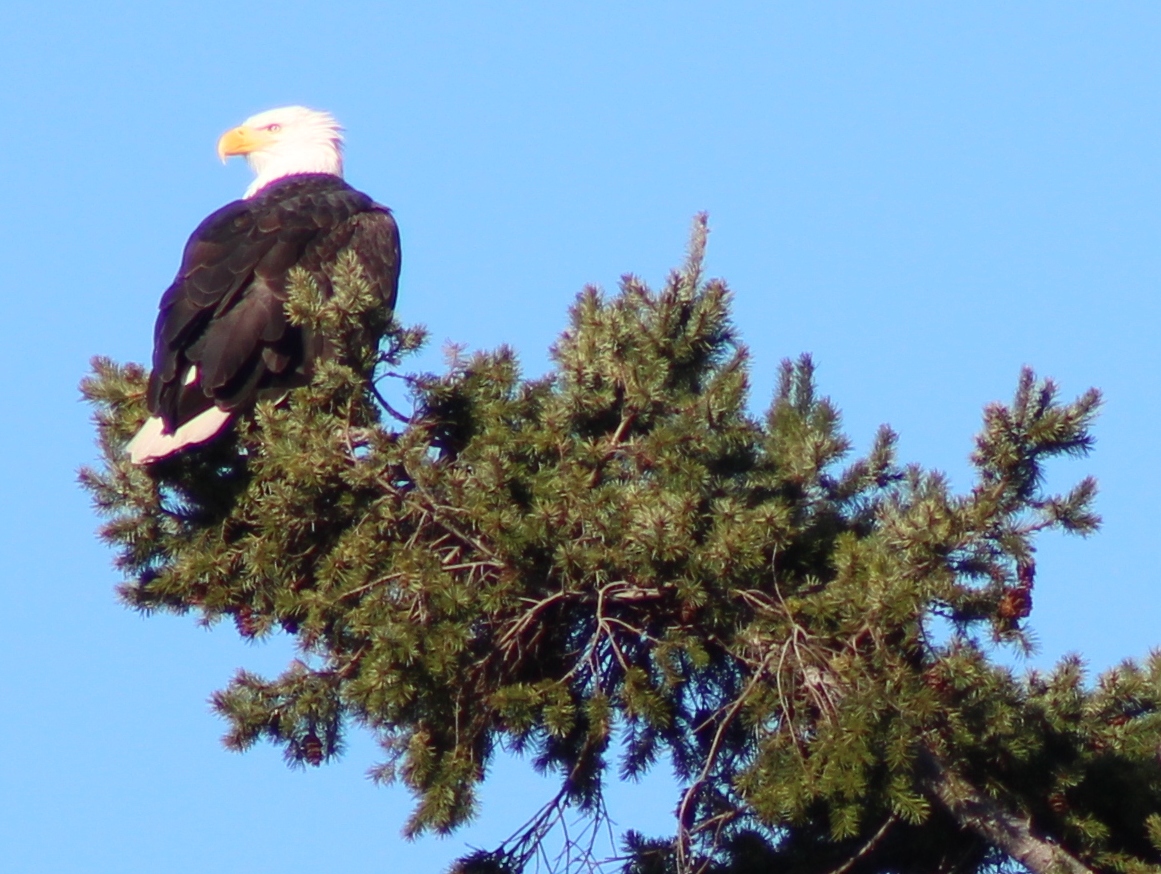
The bald eagle population in the 48 states was about 400,000 a couple of centuries ago and they were reduced to about 400 breeding pairs by the middle of the 20th century. Hunting was one of the main causes of death even after hunting eagles was outlawed. Pesticides and habitat loss contributed to the decline. there are now over 100,000 eagles in the 48 states because those who care about their welfare have been able to exert more influence than those who still wish to kill them.
Eagles had nested in the land where Eagle Landing Park is since about 1989. It is sad that they had to move away since the land was made into a park in 2005. It is possible they could move back again if those people who wish to protect the eagles would exert their influence over this few people who choose to harass them and drive them away. Besides the kids with the pellet gun, eagles can be driven away by excessive noise, such as people screaming as they walk along the trail. I have no idea why people feel the need to scream in the forest. It seems like they wouldn't be too inconvenienced if they were asked not to scream in the vicinity of the eagles' nest. If some people would like the eagles to come back, then they should say it is not okay for these few people to drive the eagles away. If the friends of the eagles remain silent, then a thoughtless few will wield disproportionate power over our environment. If anyone besides me wants the eagles to come back, they should speak up.
Friday, February 3, 2012
Most people who cause damage to the park wish to remain anonymous. I would like for them to say, publicly, "My name is _______, and I am proud that my dog crapped on the public beach every single day of the year. I think it is my right as an American to exploit the environment for my personal convenience." If people would come forward with the reasons they cause damage, maybe we could discuss how that would work out. If the environment is gone, because proud Americans used it all up, is it just too bad for Americans who come later? That's what they get for being born after us? I know I would like to see a land where there were giant trees everywhere you looked. I would like to see the wilderness of 1849, when the environment was healthy. People who came before me took away that chance. Our economy, and my ability to live my current lifestyle, is based on the destruction of the environment. I am not proud to say I am one of those people who is using up the planet's resources faster than they can be replaced.
The people who damage Eagle Landing Park will not come forward publicly and declare they have a right to do so. They conduct drive-by environmental crimes, knowing that no one is watching besides me. And what am I going to do about it? I can't punch everyone in the face who needs punching. By law, I am required to sit by and allow degradation of our public spaces. I can observe and report, but no police or local agency will respond. The taxpayers of Burien will not pay for protection of the environment. No significant group of people will approach the City Council and demand enforcement of laws that protect our common good. If I am the only one asking for enforcement, then I can be easily ignored.
"He who is silent is assumed to consent." "All that is necessary for evil to triumph is for good men to stand by and do nothing." I would agree with both those statements. I don't want to be silent. I don't want to stand by and do nothing. What can I do? I am trying to help the park, my local environment, by making the park better every day. I do this by taking pictures, hopefully raising awareness, and by removing a little ivy every day. I would like to stop the damage that occurs daily. I have not found support in the community for enforcement of environmental laws. My goal has been to see the park healthier by the end of the year. At the rate people are working against this goal, I will not succeed. It may be a Sisyphean task to carry my 365 stones up the stairs. Perhaps it is my punishment for being a member of the generation that destroyed the Earth.
The people who damage Eagle Landing Park will not come forward publicly and declare they have a right to do so. They conduct drive-by environmental crimes, knowing that no one is watching besides me. And what am I going to do about it? I can't punch everyone in the face who needs punching. By law, I am required to sit by and allow degradation of our public spaces. I can observe and report, but no police or local agency will respond. The taxpayers of Burien will not pay for protection of the environment. No significant group of people will approach the City Council and demand enforcement of laws that protect our common good. If I am the only one asking for enforcement, then I can be easily ignored.
"He who is silent is assumed to consent." "All that is necessary for evil to triumph is for good men to stand by and do nothing." I would agree with both those statements. I don't want to be silent. I don't want to stand by and do nothing. What can I do? I am trying to help the park, my local environment, by making the park better every day. I do this by taking pictures, hopefully raising awareness, and by removing a little ivy every day. I would like to stop the damage that occurs daily. I have not found support in the community for enforcement of environmental laws. My goal has been to see the park healthier by the end of the year. At the rate people are working against this goal, I will not succeed. It may be a Sisyphean task to carry my 365 stones up the stairs. Perhaps it is my punishment for being a member of the generation that destroyed the Earth.
 | |
| Stone 34 |
Thursday, February 2, 2012
 | |
| Stone 33 with eelgrass |
Jennifer Hahn spoke to the Washington Native Plant Society last night about her new book Pacific Feast. Her talk was entertaining and informative. I learned a lot about the strange seaweed species I see on the beach from time to time. I am not an adventurous eater, so I can't see eating most of the plants and animals she talked about. Even if I wanted to, it would not be legal or healthy to eat these things in Eagle Landing Park. Except for the berries. If people want to eat Himalayan blackberries, they definitely should. The environment would be better served if people removed the whole blackberry plant rather than just eating the berries. As for clams and seaweed, it is not legal to harvest them in Eagle Landing Park, and the water is too polluted. I wish she had a recipe for English Ivy Casserole.
Hahn emphasized stewardship, which is good. Her thesis is that eating local is good for the environment and good for your health. The main problem with this is that people should not be foraging for food on public lands near population centers because those lands need protection from overuse and abuse. If you go to the wild, remote areas where Hahn's advice could be followed, you are no longer very local. You've used those resources to travel 30 miles for one meal, or five meals. This is not environmentally sound or sustainable. I could see Hahn's book being useful for people who are going hiking or camping anyway. I don't see how the majority of people could get a benefit from her book, or benefit the environment, unless they are eating dandelions and blackberries.
Hahn suggested that when we take from the wild, we pause to say thank you to the environment for its gifts. This puts one in the right frame of mind, acknowledging that the Earth does not belong to us to exploit and that we have a duty to be good stewards. I support her suggestion, and I would be grateful if more people had that mindset. However, a better way to say thank you to the environment is to stop destroying it. The lifestyle of the average American is not sustainable or environmentally sound. I would venture to say that most environmentalists have not achieved a lifestyle where they do more good than harm to the planet. I know that is my goal, to be a part of the solution and not the problem, and I have not achieved that goal. Rather than pausing to say thank you to the environment when you take a fish or a clam or a handful of berries, it would be better for all if you said thank you by not driving your car or buying that new TV.
Wednesday, February 1, 2012

In the picture above you can see some little specks that are actually ducks. They eat the eelgrass growing on the sandbar. It is just at the right depth where it can get lots of sun and where the ducks don't have to dive too deep for it. This sandbar is maintained by landslides and by the constant erosion of soil into Puget Sound. At low tide, you can see where the eelgrass grows. It only becomes exposed to air, briefly, when the tide is -3 feet or more. Eagle Landing Park extends out about 300 feet westward from the high tide line, and the half acre of eelgrass, Zostera marina, is an important component of the park's ecology.
 | |
| Stone 32 |
Tuesday, January 31, 2012

A dog can be quite useful in spotting wildlife sometimes. They can smell when an unusual critter is about. A dog's eyesight is not great in some respects, but if it moves, a dog can see it better than a person can at night. Kelsy cannot see her orange ball sitting in the middle of a green lawn, but if it moves, she's all over it. I pay attention to what the dogs notice. They have pointed out coyote scat in the area.
It seems like I have always had dogs, but there was actually a time when I was dogless. Way back then, I used to see foxes quite often. One fox in particular would come barking along every afternoon at four. Now that I have dogs with jingling collars and tags, foxes are always long gone before I come into viewing range. I assume they are still around.
Monday, January 30, 2012

As I walked through the park, I saw that three Garry oak trees have survived the snow, ice , and wind. They grow so slowly that I will be a very old man before I can stand in their shade. I hope they survive to provide shade for future generations. The Garry oak tree is dependent on humans for its survival. It is one of the few native species that actually requires human intervention. Well, all species need our intervention in the sense that we had better start protecting the environment before it is gone. However, Garry oak co-evolved with humans, and it adapted to a regime of fire clearing away the underbrush and faster growing seedlings. Now that indians are no longer burning the prairies for camas bulbs, the Garry oak relies on those individuals that are willing to provide it a home. Ironically, next to a paved street is the ideal habitat for a Garry oak. It doesn't need much. It just needs to not be shaded out by faster growing species like Douglas-fir.
If I had a typical house on a standard lot on flat land, I would plant a Garry oak prairie in my front yard, with native wildflowers. It would provide the openness that people like. The back yard would be full of rioting native plants growing thick and wild. The front yard could look very tame and civilized while still being great habitat with high ecological value. I have planted several Garry oaks in my yard, but not with the typical prairie flowers. I hope their positions, near the street and away from power lines, will give them a chance at living their full 300 years as the property is bought and sold. I like to visit the grand Garry oaks at the south edge of Seward Park and imagine what my oak trees will look like in a couple hundred years.
Subscribe to:
Posts (Atom)